
Guest blogger Andy Smarick posts regularly (although generally with fewer acronyms) on Fordham's Flypaper blog.
A recent Common Core-sympathetic article carried by the WSJ begins with an anecdote about a too-seldom mentioned potential upside of tougher standards: that fewer parents will need to pay for remedial courses when their kids reach college (“something parents of about a quarter of all New York students entering college now do”).
It’s a lot easier to say “Common Core implementation” than to do it.
But what really comes through in this article is that it’s not completely clear what “Common Core implementation” actually means. This is something I’ve been fretting about since my time at the New Jersey Department of Education.
Though the reporter and numerous sources quoted throughout the article use buzz words (“rigorous,” “complex texts,” “ready for college and career success,” “mapping backward,” “analytical reading and writing skills,” and “text-based instruction.”), their translation into real-life practice is garbled English at best, ancient Greek at worst.
It seems to me that many of the Common Core’s most strident defenders don’t understand or appreciate that state and local leaders don’t know exactly what they should be doing. That confusion trickles down to teachers, preparation programs, and lots of other players. In short, it’s a lot easier to say “Common Core implementation” than to do it.
This is why Checker Finn’s piece about “How the Common Core changes everything” is so valuable. And scary. Finn lists twenty areas of practice and policy that will need to be amended—in some cases adjusted, in others overhauled—if we’re to successfully transition to these new standards.
The list includes everything from ESEA and accountability systems to NAEP and graduation rates to technology and the school day to teacher evaluations and curriculum guides.
Finn’s list is a great start. I worry that policymakers and education thought leaders would be astonished and terrified if they realized how far behind the field is on these issues. Worse, it’s not at all clear who is doing what already or who is ultimately responsible for leading on each of these issues (SEAs? LEAs? Schools? Individual teachers? The market?).
A big part of my education in doing state-level work after lots of think-tankery and bouncing around the federal government can be boiled down to the acronym “ATAMO.”
In this case, were you to make a step-by-step guide for transitioning from state standards and assessments to common standards and assessments, you’d probably begin with, “organize a group of standards experts.” Further down the list would be “have draft standards reviewed by higher education and business leaders,” and “acclimate state boards of education to new standards prior to proposed adoption.”
Toward the end, maybe #746, would be “check that new standards have been implemented faithfully in each classroom across the nation.”
Somewhere on the checklist—as the work moves from the feds, CCSSO, and D.C.-based wonks to actual classrooms where teachers teach and students learn—would appear “ATAMO.”
And then a miracle occurs.
We’ve been so excited about Common Core and all of its benefits that we’ve spent entirely too little time working out the nasty details that Finn enumerates, the details that make all the difference to practitioners and kids.
Someone needs to replace ATAMO with a game plan PDQ or things aren’t going to end well.
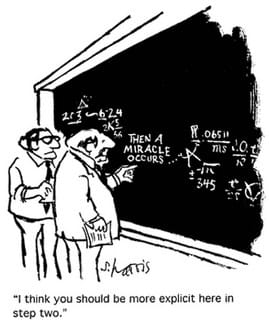 Photo by Jessica Allan Schmidt. |